Received a Code Violations Notice in Charlotte? Here Is What Happens Next
The letter arrives with a list of problems and a date to fix them. The grass is too tall. The windows are broken. The house has been empty for months, or a tenant has complained about unsafe conditions. You know the work needs doing. What you do not know is how you will pay for it before the city’s deadline. A Charlotte code enforcement notice is serious, but it does not mean you have lost the house or that selling is impossible. First, find out which rules apply and what the city wants you to correct. Then choose whether to repair, ask for more time, appeal, seek assistance or discuss selling the house as-is.
John Buys Your House works with Charlotte homeowners who want to move on without paying for major repairs first. This guide explains the city process, what it can cost and how to decide what to do next.
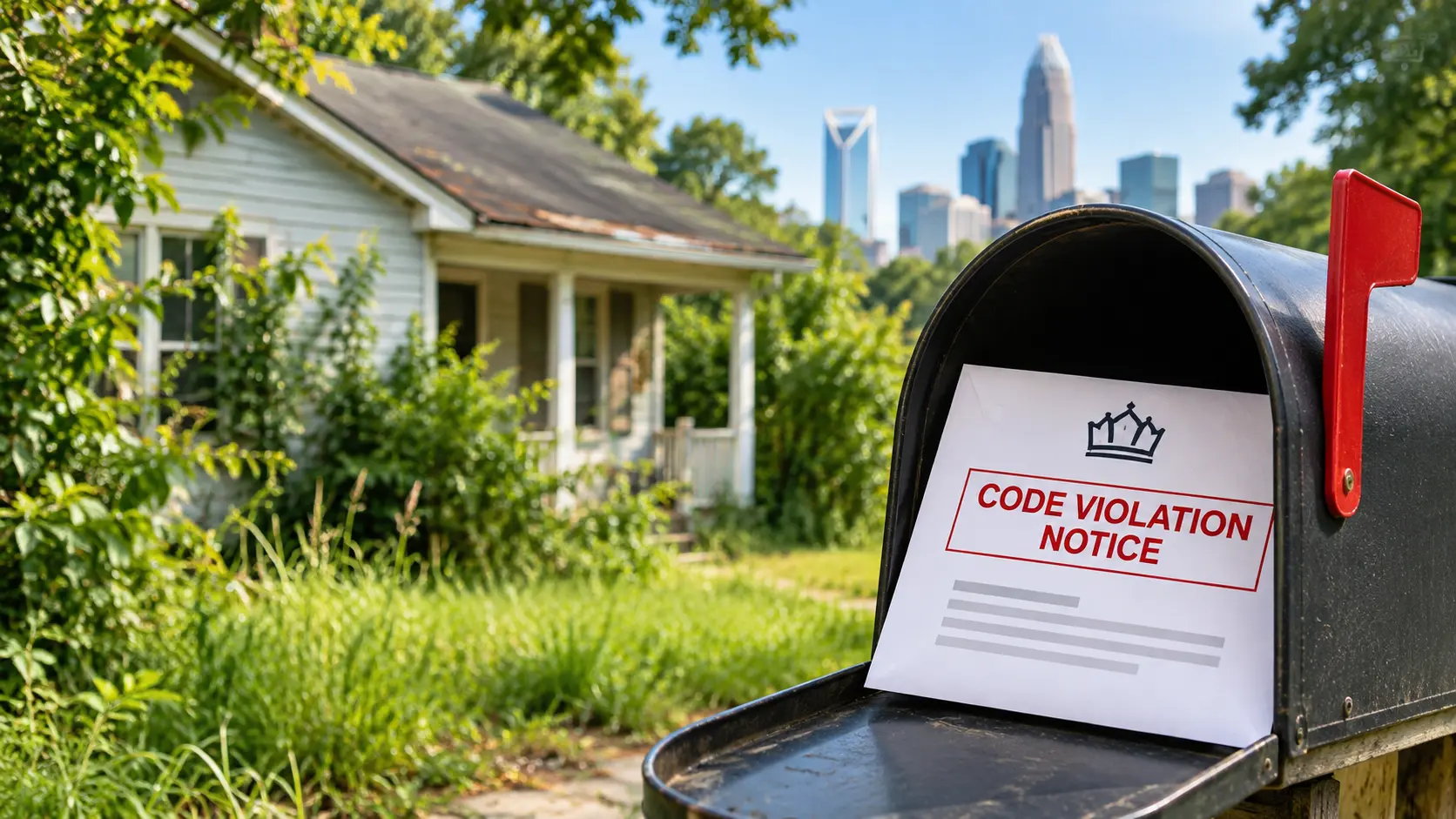
Why Would the City of Charlotte Open a Code Enforcement Case?
Sometimes, it starts with something as simple as a neighbor reporting an overgrown yard. Other times, a tenant calls the city because the heat isn’t working, or an inspector notices a vacant house that has been neglected for years. Before the homeowner knows it, there is a letter from Charlotte Code Enforcement asking for problems to be corrected.
This raises an important question: What exactly brought the property to the city’s attention, and what happens next? In Charlotte, a case can begin when an inspector spots a problem during patrol or someone reports it through 311, the online portal, or the CLT+ app. But not every violation is handled the same way. For instance, an overgrown yard or piles of trash fall under the city’s health and sanitation rules. A house with unsafe electrical wiring, broken plumbing, or no working heat raises minimum housing concerns. Other cases involve unsafe commercial buildings, zoning violations, or property uses that don’t follow city rules. It is therefore important to understand which rules apply because the type of violation determines what the city expects the owner to correct and which enforcement process follows.
Who Enforces the Rules in Charlotte and Nearby Towns?
There is also an important difference between owning property in Charlotte and owning property elsewhere in Mecklenburg County. Inside Charlotte city limits, the city’s Code Enforcement Division handles these cases. In Cornelius, Davidson, Huntersville, Matthews, Mint Hill, and unincorporated Mecklenburg County, the county handles minimum housing enforcement, while each town handles its own nuisance and zoning complaints. Mecklenburg County also handles building permits throughout the county. So, if you have received a code enforcement letter, don’t assume that every rule or deadline you have read online applies to your property. Start by identifying which department issued the notice and what it is asking you to fix. That’s the first step toward understanding your options.
What Types of Problems Can Trigger a Code Violation?
It doesn’t always take a major structural problem to get the city’s attention. Sometimes, it’s grass that hasn’t been cut, an abandoned car sitting in the driveway, or piles of junk left behind after someone moves out. Other times, the problems are harder to see from the street. A tenant has been living without reliable heat, a roof has been leaking for months, or an older house has electrical and plumbing problems that nobody has addressed. What starts as one complaint can uncover a much longer list of problems that need attention.
In Charlotte, the violations generally fall into several categories.
- Health & Sanitation (nuisance): upkeep of the outside of the property. City Code sections 7-105, 10-140, 10-155, 10-156.
- Minimum Housing Code: safety and cleanliness of homes, rented or owner-occupied.
- Non-Residential Building Code: offices, retail, warehouses, factories, restaurants.
- Zoning (Unified Development Ordinance): permitted uses, accessory structures, home businesses.
- Boarded-Up Registration (sections 5-1 to 5-10): register within 48 hours of boarding, board all openings, boarding allowed up to 6 months.
- Parking (Chapter 14): no parking on front or side lawns; vehicles must be on concrete, asphalt, gravel or similar.
- Housing code covers heat, water, electricity, smoke and CO detectors, structural safety, and serious electrical, plumbing, heating or structural problems. It does not cover appliances, or mold itself, though leaks causing mold are covered.
- Permits: a shed or carport with every wall 12 feet or shorter needs only a city zoning use permit. Larger structures also need a county building permit.
- Large apartment complexes (more than 24 units): a full assessment of the property starts once 10% of units have been inspected within 24 months.
For owners of vacant or neglected houses, boarding up the windows isn’t the same as resolving the underlying property problems. And that’s where the real challenge begins. As a homeowner, you might be dealing with an overgrown yard, an unsafe interior, and a zoning issue at the same time. Each problem comes with its own requirements, and fixing one doesn’t automatically resolve the others. That’s why it is important to understand the full list of violations before spending money on repairs or deciding to sell the property. You need to know exactly what the city expects, which problems need attention first, and how much time you have to act.
How Much Are Charlotte Code Violation Fines?
A notice can turn into a bill when a problem remains unresolved. The city’s listed nuisance and repeat-offender citation amounts include the following:
| Violation | Fine |
| Illegal dumping | $500 |
| Carts, yard waste, bulky items, junk, accumulation, neglect | $150 |
| Illegal sign | $100 per sign |
| Lawn parking | $25 per occurrence |
| Chronic/repeat violator, 1st–3rd | $150 |
| Chronic/repeat violator, 4th | $250 |
| Chronic/repeat violator, 5th+ | $500 |
Separate housing enforcement actions can carry civil penalties of up to $100 per day for unresolved violations. Over time, those charges add up. Zoning citations can also increase when violations continue. Check the actual notice and invoice for the rule and amount applied to your case; these are Charlotte figures, not a schedule for surrounding towns.
The takeaway? Ignoring a code violation doesn’t make it go away. What begins as an unpaid cleanup bill or an unresolved repair can become a lien, complicate a future sale, and create additional problems for owners with more than one property.
What Happens After the City Sends a Notice?
The next steps depend on the type of case. Keep the city’s letter close: it tells you what was found, what must change and when an inspector expects action.
Nuisance and Yard-Condition Cases
- An inspector visits, confirms the condition and photographs it.
- The city sends a letter identifying the violation, required correction and deadline.
- The inspector returns for a follow-up inspection and tries to contact the owner.
- If the problem remains, the city can issue a citation, hire a contractor and bill the owner (with a lien if the bill remains unpaid), or refer the case to Environmental Court.
- Citations and city-contractor bills can be appealed within 30 days.
Zoning Cases
- The city inspects a reported zoning problem within three business days.
- A Notice of Violation explains what is wrong, how to correct it and the case-specific deadline.
- If the issue is not corrected, the city can issue a citation and increase penalties as noncompliance continues.
- An owner challenging the zoning decision appeals to the UDO Board of Adjustment.
Minimum Housing Cases: From Inspection to Repair Order
A housing case has a more formal process because the issue is whether the building is safe to occupy. Under North Carolina G.S. 160D-1203 and Charlotte’s housing process, the steps are:
- The case begins with a tenant request, agency referral, an inspector’s observation, or a petition signed by five Charlotte residents age 18 or older. An inspector attempts to contact the owner or tenant within three business days.
- A formal complaint is served on the owner and people with recorded interests in the property, including a mortgage lender. It sets a hearing 10–30 days after service.
- At the hearing, the owner can submit an answer, attend and testify. Formal court rules of evidence do not apply.
- If the inspector finds the home unfit, written findings explain why. The order directs repair when the cost is reasonable compared with the home’s value, or repair or demolition when it is not.
- Repair deadlines are typically 60 days. Extensions are possible; the city describes an example of an additional 30 days. Even after a demolition order, an owner can choose repairs within the allowed period.
- An owner can appeal to Charlotte’s Housing Appeals Board. The appeal period is generally 10 days under state law; check the specific notice.
- If the owner does not act, City Council can approve an in rem ordinance allowing the city to repair, close or demolish the building. The ordinance is recorded with the Register of Deeds under the owner’s name. Civil penalties and Environmental Court are other enforcement options.
- The case remains open until the required work, permits and inspections are completed and approved.
What If You Cannot Complete the Repairs Before the Deadline?
The deadline is important because the city’s options go beyond sending another letter. A neglected exterior can lead to contractor charges. A serious housing order can lead to a lien being recorded by the city, a closed building, or a demolition by the city. That raises a practical question for owners: Is it better to put more money into the house, or make a plan to sell the property?
- Civil penalties: fines of up to $100 per day for unresolved violations. This can quickly become thousands of dollars in fines if not addressed
- Chronic status: 4 or more violations in the prior calendar year means escalating fines and abatement. It counts violations across all properties one owner holds (big deal for investors). “Repeat” status is per property and excludes vehicles and signs.
- Liens: the city’s cost to repair, close or demolish becomes a lien on the property. It is also a lien on the owner’s other real estate within the city or within 1 mile of it; the primary residence is excluded.
- Abandoned houses: if a house has been vacant and closed for 1 year, Council can find the owner has abandoned intent to repair. The owner then has 90 days: repair or demolish if repairs cost 50% or less of the home’s value; demolish if more.
- Placards: the city can post a closed building, and occupying a posted building is a Class 1 misdemeanor.
- Unsafe buildings: inspectors post them, order a title search, and work with owners and insurers.
- Story angle for heirs: when no estate is opened, notices can go to an empty address, and a case can move forward with no heir aware of it.
How to Check a Charlotte Property Before the Next Notice Arrives
- Start with the official Charlotte Code Cases search.
- Enter the property address, parcel ID or case number.
- Check the case status and any available letters.
- Verify the mailing address in Mecklenburg County Real Estate Lookup or POLARIS.
- Ask the inspector which items need immediate correction and whether a deadline extension is available.
- Have a closing attorney search the Register of Deeds for recorded liens or in rem ordinances. For zoning questions, use Charlotte Explorer or call 704-336-7600.
- Search Charlotte Code Cases – official city lookup
- Contacts: 311 or the CLT+ app; zoning staff 704-336-7600; pay invoices at charlottencpay.com; towed vehicles 704-336-3380. Housing petitions go by mail to Code Enforcement Division, 600 E. Trade St., Charlotte, NC 28202. If the owner died and notices went to an empty house, check the record immediately rather than assuming the city has stopped the case.
What Are Your Options: Repair, Ask for Time, Appeal or Sell?
There is no single right answer for every house. What matters is knowing what the city requires and choosing a plan before the deadline passes.
Complete the Required Repairs
If you want to keep the property, use the notice as your work list. Housing repairs that require permits need licensed contractors, Mecklenburg County permits and passing inspections. Keep photos, receipts and communications with the inspector.
Talk to the Inspector Before the Deadline
Call the assigned inspector and ask which corrections matter first and whether an extension is available. Do it before the deadline, not after the next citation arrives. If the property is a registered pollinator garden or naturalistic landscape, register it with the city within 30 days of a notice so compliant planting is not treated as overgrowth.
Challenge a Finding Through the Right Appeal Process
For nuisance citations and contractor bills, the appeal window is 30 days. Zoning notices go to the UDO Board of Adjustment. Housing orders go to the Housing Appeals Board; the state-law default is generally 10 days, so verify the date printed on your notice.
Ask About Repair Assistance
For owners who want to stay, Charlotte’s Housing Rehabilitation and Lead Hazard Control programs can help with qualifying work, including concerns in pre-1978 homes. Other starting points include Habitat for Humanity Critical Home Repair at 704-716-5639 and Blue Ridge Community Action Weatherization at 828-438-6225. Eligibility and funding are program-specific.
Sell the House in Its Current Condition
If the repairs are beyond your budget or you no longer want to manage the property, a direct purchase offers another path. John Buys Your House reviews the house as it stands today, including the notice and the work required. We do not ask you to finish renovations before we evaluate it. A completed sale transfers ownership and responsibility for the remaining property work as agreed; it does not make an existing violation or lien vanish. The closing attorney confirms what must be addressed for title to transfer.
See the other difficult-property situations we help Charlotte sellers navigate
Can You Sell While a Charlotte Code Case Is Still Open?
Yes. An open case is a condition to investigate, not an automatic ban on a sale. What changes is the amount of information the buyer and closing attorney need before moving forward.
| Your situation | What to understand | Practical next step |
| Yard or nuisance notice | Correction deadline, reinspection and any city charges | Get the notice and current case status; compare cleanup costs with an as-is offer. |
| Housing repair order | Required work, hearing or appeal status, permits and inspections | Share the complete order and deadline with the buyer and closing attorney. |
| Recorded city lien or in rem ordinance | Recorded claims can affect title and closing | Have a North Carolina closing attorney identify required resolutions and payoffs. |
| Vacant or boarded-up building | Registration, safety and possible closure requirements continue | Confirm the case status and explain occupancy and condition. |
| Zoning violation or permit problem | City zoning and county building permits are separate | Identify the exact approvals and any open corrective action. |
| Inherited property with an outdated mailing address | Estate authority and missed city notices can complicate timing | Verify ownership, estate status and the city case before agreeing to a closing date. |
A traditional listing can work when the property is ready and time allows. A direct cash purchase is useful when the cost of contractors, cleanup, inspections and carrying the property no longer fits your plans. You can compare both options without committing to our offer.
Common Problems That Make a Code Violations Case Harder to Resolve
- An inherited house no one has been checking. The notice goes to the deceased owner’s address while family members are sorting out the estate. Before a sale, a North Carolina attorney confirms who can sign. Our probate guide explains the ownership side of that process.
- A tenant reporting unsafe conditions. A complaint about heat, water, detectors or structural problems can trigger a housing inspection. A sale does not cancel tenant rights or the existing lease.
- A vacant house that keeps deteriorating. Overgrowth, break-ins, boarded openings, utility problems and taxes continue even when nobody lives there.
- Multiple rental properties. Chronic-violator status can count problems across the same owner’s Charlotte properties, not just one house.
- A house with debt and major repairs. Code bills, property taxes, mortgages and recorded claims all deserve a title review before closing.
- Unfinished work or a disputed property use. County building permits and city zoning approvals must be checked separately.
Read about selling a house during probate in North Carolina
See options when back property taxes are also a problem
Selling a Problem Property As-Is Instead of Managing Every Repair
Sometimes the hardest part is not one broken window or one city letter. It is the feeling that every fix reveals another expense. If your goal is to stop maintaining the house, we can review it without asking you to clear the yard, replace systems or stage the rooms first.
- We evaluate the property in its existing condition and account for the work in our offer.
- Our direct cash purchase has no lender financing contingency.
- We explain the offer so you can decide whether it makes sense.
- A North Carolina real estate attorney checks ownership, recorded claims and closing requirements.
- There is no obligation to accept our offer, and you can compare it with repairing or listing.
See how John Buys Your House calculates a cash offer and handles closing
Get An Offer Today, Sell In A Matter Of Days…
What Should You Have Ready When You Contact Us?
You do not need to solve the city’s case before starting the conversation. Share what you have with us.
- The property address and your name or the name shown on the deed.
- The city notice, case number, inspector’s name and next deadline.
- Any hearing notice, repair or demolition order, appeal paperwork, citation or contractor invoice.
- Information about recorded liens, mortgages, unpaid taxes or estate ownership.
- A simple description of the property’s condition, whether anyone lives there and any work already completed.
- Your preferred timing and what you want to happen after the sale.
How John Buys Your House Helps
- Tell us what is happening. Start with the property address, the code notice and what has become difficult about keeping the house.
- We review the property as-is. We look at its condition, local market, needed repairs and the city’s outstanding requirements.
- We explain our cash offer. If the house fits our buying criteria, we show you how we arrived at the offer. You decide whether to accept.
- The closing attorney checks title and obligations. Ownership, liens, city orders and any necessary payoff or release requirements are reviewed before closing.
- We close when the transaction is ready. Once the required conditions are satisfied and the sale closes, you receive the net proceeds on your settlement statement. We take ownership and handle the work assigned to us under the purchase arrangement.
Code Enforcement Terms Explained
| Term | What it means |
| Code violation | A condition or use that does not meet an applicable city rule. |
| Notice of Violation (NOV) | Written notice explaining the issue, required correction and deadline. |
| Nuisance / health and sanitation | Exterior conditions such as junk, overgrowth, litter and improper waste storage. |
| Minimum Housing Code | Basic health and safety requirements for residential buildings. |
| Zoning / UDO | Rules governing land use, structures, setbacks and allowed activities. |
| Reinspection | Inspector’s follow-up visit to check whether corrections were made. |
| Abatement | City-arranged work to correct a violation, with costs charged to the owner. |
| Civil citation / penalty | Money charged for violating or continuing to violate a rule. |
| Chronic violator | Owner meeting the city’s repeat-violation threshold across properties. |
| Findings of Fact | A list of violations and issues associated with a property. This is provided by the code enforcement inspector after an inspection of the property |
| Repair order | Formal direction to correct conditions in an unfit building. This happens during or after the Findings of Fact |
| Demolition order | Formal action requiring demolition or allowing timely repair as provided by law. This happens during or after the Findings of Fact. |
| In rem ordinance | City Council action against a property authorizing repair, closure or demolition. |
| Lien | Recorded claim against real estate for money legally owed. |
| Housing Appeals Board | Charlotte board hearing appeals from housing-code orders. |
| UDO Board of Adjustment | Board hearing appeals involving zoning enforcement. |
| Clear title | Ownership transferable after required claims and restrictions are addressed. |

real 5 star google reviews from homeowners in charlotte & nearby NC
Don’t just take our word for it!
“I worked with John to sell a house that had become problematic due to a tenant a, not paying rent and b, wracking up expensive liens and code enforcement violations. He was incredibly helpful in a variety of ways – he is well connected and knew the right people to get me out of the situation; he is patient and calming, so when the process gets complicated and difficult he can explain and walk you through it and keep everything calm. This was the best outcome for my situation, so while I don’t ever want to be in the situation I was in that brought me to John again, if I ever need to use JohnBuysHouses again, I would do so without hesitation or regret.”
– Matthew Gouyd
“This transaction was seamless. I appreciate the quick turn around. My advice is to have knowledge of what you’re selling, it will make the communication better. I was not low balled or taken advantage of. The offer I was presented was negotiable and well thought out considering the property. I appreciate the acknowledgment of my knowledge as an NY closing agent to the point where we all understood each other which made it extremely easy. My childhood home is in good hands.”
– Courtney M
“I’m thrilled with the service I received from John Buys Your House, the real estate investor who assisted me in selling my property. Their market knowledge and dedication were impressive.
John Buys Your House provided a competitive offer, ensuring a quick and smooth sale. They were always available to address my questions. I highly recommend John Buys Your House for a hassle-free selling experience. Thank you for your outstanding service!”
– Zach Flowers
Common Questions About Charlotte Code Enforcement
Can I sell a house with an open code violation in Charlotte?
Yes. A pending code case does not automatically prevent a sale. The buyer needs the notice and case status, and the closing attorney must address recorded claims and title requirements. The remaining work stays with the property and is handled under the sale arrangement.
Who reported my property?
Many code reports are anonymous. Charlotte accepts complaints through 311, its online portal and CLT+. Housing petitions signed by five adult city residents are public records.
How long do I have to fix a code violation?
Read your notice. Nuisance and zoning deadlines depend on the case. Housing repair orders typically allow 60 days, with extensions possible. A housing appeal deadline is generally 10 days under state law; check your notice.
What if I never got the violation letter?
Look up the case online and check the mailing address recorded in Mecklenburg County property records. Contact the inspector promptly; an outdated address does not mean the enforcement process stopped.
Can the city demolish my house?
Yes, through the required housing and unsafe-building procedures. A housing order can permit repairs instead of demolition within the stated period. City Council action can authorize repair, closure or demolition when an owner does not comply.
Will a code lien show up when I sell?
A recorded lien can affect the title review and what must be paid or resolved at closing. The closing attorney checks the public record and determines the required steps.
My tenant called code enforcement. What now?
The city can inspect minimum housing conditions and notify the owner about required repairs. Tenant rights and the lease continue to matter even if the property is sold.
Can the city fine me every day?
Certain unresolved housing violations can lead to civil penalties of up to $100 per day. Other violations have different citation schedules. Confirm the rule and amount on the notice or invoice.
Do Charlotte rules apply to a house in Matthews or Mint Hill?
No. Charlotte’s nuisance rules apply within city limits. Mecklenburg County handles minimum housing in specified towns and unincorporated areas, while towns enforce their own nuisance and zoning rules.
Can I sell without fixing the yard or interior first?
We evaluate houses in their current condition. A direct purchase does not require you to complete the work before asking for an offer. Existing city cases and recorded claims still need proper
Helpful Charlotte Code Enforcement Resources
Use the city’s official records first. A case number, actual notice and recorded property information are more useful than relying on general timelines alone.
- City of Charlotte – Code Enforcement
- Charlotte – General Code Enforcement Information
- Charlotte – Minimum Housing Code
- Charlotte – Search Code Cases, Letters and Demolition Orders
- Charlotte – Report a Violation / CLT+ / 311
- Charlotte – Zoning Questions and Enforcement
- North Carolina – G.S. Chapter 160D, Article 12
- City of Charlotte – Housing Services and Repair Assistance
- Mecklenburg County – Property and Permit Services
- Town of Mint Hill – Local Government
Useful contacts: Charlotte 311; zoning and code questions 704-336-7600; towed vehicles 704-336-3380; city invoices at charlottencpay.com. For minimum housing petitions: Code Enforcement Division, 600 E. Trade St., Charlotte, NC 28202. For repair assistance: Habitat for Humanity Critical Home Repair 704-716-5639; Blue Ridge Community Action Weatherization 828-438-6225.
The Notice Is a Deadline. It Does Not Have to Decide Your Future.
A code enforcement letter can make a house feel like a problem with no end in sight. Start by checking the case, the deadline and the exact work the city requires. If you want to keep the house, make a repair or appeal plan with the right office. If you are ready to sell, ask what the property is worth in its current condition before paying for another round of repairs.
At John Buys Your House, we listen to what is happening, review the property and explain a no-obligation offer. We cannot promise that every city deadline or title issue will be resolved by a particular date. What we can promise you is a clear conversation about the house, the process and what we are prepared to take on if we buy it.
Yes, the city has its requirements. So, even if they have issued you a deadline, that doesn’t mean it has taken away your options.
General-information disclaimer: This page is educational, not legal advice. Code rules, penalties, appeal periods, permit requirements, liens and sale timelines depend on the notice, property location and applicable law. Confirm deadlines with the enforcement office and consult a North Carolina-licensed real estate attorney about title and closing.
Get An Offer Today, Sell In A Matter Of Days…


If you have had an experience with John Buys Your House and would like to share your story, we would love to hear from you! Please send us a message to share how your journey with John Buys Your House has been. Your feedback is invaluable to us and helps us continue to improve and provide top-notch service.
John Buys Your House is here to help you!
If you are trying to sell a house as is in Charlotte, dealing with an inherited property, facing repairs, managing tenants, or simply unsure what to do next, let’s start with a conversation.
We will look at the property, understand your situation, explain your options, and make a fair cash offer if selling directly makes sense.
If you still have questions about how it works or want to speak with our team, give us a call! We are happy to answer any questions you have.